
TC-Helicon Mic Mechanic 2 Review:
I Wasn’t Looking for an Effect. I Was Looking for a Room.
For the solo singer-songwriter, simplicity is a feature. But sometimes simple isn’t quite the same thing as subtle.
There is a particular kind of gig that doesn’t require very much.
One singer. One acoustic guitar. A microphone. Maybe forty or fifty people sitting in a coffeehouse, listening room, brewery or small theater.
There’s no elaborate production. Maybe there’s a small PA and somebody running sound. Sometimes there isn’t. The entire appeal of the evening is that there isn’t much standing between the songs and the people listening to them.
For that kind of performance, I’ve been looking for something that seems like it should be remarkably easy to find: a simple, great-sounding vocal reverb pedal.
Not a vocal processor.
Not a harmonizer.
Not something that requires presets, menus or an afternoon with the manual.
Just something I can put between a microphone and a PA that gives a dry vocal a little bit of space without making it sound obviously processed.
That search eventually led me to the TC-Helicon Mic Mechanic 2.
And on paper, it comes remarkably close to what I’ve been looking for.
A Very Good Idea
The philosophy behind the Mic Mechanic 2 is hard to argue with.
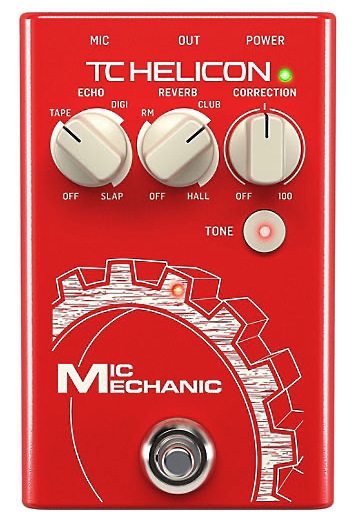
It’s a compact vocal stompbox with XLR input and output, reverb, echo, pitch correction and TC-Helicon’s Adaptive Tone processing. That Tone feature automatically handles some EQ, compression, de-essing and gating without asking the singer to become a sound engineer in the process.
That last part matters.
There are some remarkably powerful vocal processors available today, but power isn’t necessarily what every singer needs.
If I’m walking into a small room carrying an acoustic guitar, a microphone, a cable bag and maybe a little PA, I’m actively trying to bring less gear with me. I don’t want another device that requires programming.
The Mic Mechanic 2 understands that.
There are three large controls: Echo, Reverb and Correction. There's a Tone button and a footswitch. You plug your microphone into one side and send the output to your mixer or powered speaker. It can even provide phantom power for a condenser microphone.
That’s refreshingly straightforward.
And it’s one of the things I genuinely like about this pedal.
Then I Turned Up the Reverb
Unfortunately, reverb was the primary reason I wanted it.
And this is where the Mic Mechanic 2 and I part ways.
TC-Helicon describes the pedal as providing “studio-grade” reverb and echo, and the Reverb control allows the singer to select the type and amount of reverb being applied.
There is nothing inherently bad about these sounds.
They simply don't accomplish what I want reverb to accomplish on an intimate singer-songwriter gig.
I don't really want to hear reverb.
I want to miss it when it's gone.
That's an important distinction.
A good live vocal in a small room needs a little dimension. A completely dry microphone can feel almost unnaturally close, particularly through a small PA. Just a touch of ambience can let the vocal breathe.
But for folk, Americana and acoustic music, I want that ambience to remain almost invisible.
With the Mic Mechanic 2, I had difficulty finding that sweet spot.
At lower settings, I kept wanting just a little more dimension. As I brought the reverb forward, I became increasingly aware that I was listening to an effect.
For another singer, in another genre or another room, that might be exactly what they're looking for.
For me, it wasn't.
I wasn't trying to put my voice into a digital room. I wanted the room around my voice to feel a little better.
The Rest of the Pedal Makes Sense
Interestingly, my criticism of the reverb shouldn't overshadow how intelligently the rest of this pedal is designed.
Pitch correction, for example, isn't something I went looking for. But I appreciate TC-Helicon's approach to it.
The Correction control can be turned completely off, or it can be introduced gently. TC-Helicon describes the feature as auto-chromatic correction intended to subtly move the vocal toward pitch without creating an obviously robotic sound; more aggressive settings are available if that's the desired effect.
That's sensible.
The Adaptive Tone feature may actually be more useful to a working singer-songwriter than some of the flashier things found in larger vocal processors. Press one button and the pedal applies adaptive EQ, compression, de-essing and gating.
For somebody walking into a different room every night, there's real value in that.
And echo is available for singers who use it, without getting in the way of those who don't.
The Mic Mechanic 2 isn't overloaded with features for the sake of putting more features on the box.
That's something I appreciate.
A Small Note About the Hardware
I do wish the physical controls felt a little more substantial.
This is subjective, of course, but the knobs don't have the tactile quality I associate with some of my favorite pieces of road gear.
That's not a deal breaker at this price point, and the enclosure itself feels much more reassuring than the knobs sitting on top of it.
Still, singer-songwriters are notoriously hard on equipment.
These things end up in backpacks, cable bags, pedalboards and the back seats of cars. They're plugged in and unplugged constantly. They're stepped on in dark rooms.
For a product designed specifically for live performers, I'd happily pay a little more for controls that feel equally roadworthy.
Maybe I'm Looking for a Product That Doesn't Quite Exist
The Mic Mechanic 2 ultimately clarified something for me.
I don't think I'm looking for a better vocal effects processor.
I'm looking for something slightly different.
Call it a singer-songwriter vocal pedal.
And if somebody wants to build it, here's my wish list.
Give me XLR in and XLR out.
Give me phantom power.
Give me a really good microphone preamp.
Give me a gentle compressor that's either automatic or controlled by one knob.
Then spend most of the development money on the reverb.
Give me three exceptional choices:
Room. Plate. Hall.
Give me control over the amount and decay.
And then stop.
No screen. No elaborate presets. No harmonies. No looping. No need to save patches.
The goal shouldn't be to make my voice sound different.
It should be to make a microphone plugged into a small PA feel a little more like a microphone plugged into a great sound system in a great room.
That's a subtle distinction, but I suspect I'm not the only acoustic performer looking for it.
So, Who Is the Mic Mechanic 2 For?
I can see this pedal making a lot of sense for the singer who wants an affordable, extremely compact way to take more control over their vocal sound.
If you routinely play venues where you're never quite sure what the PA situation will be, having Adaptive Tone, pitch correction, echo and reverb sitting at your feet in one small box is legitimately useful.
It's also wonderfully easy to understand.
There are no screens staring back at you. You don't need to build a preset for every song. The learning curve is almost nonexistent. TC-Helicon calls the Mic Mechanic 2 an “ultra-simple” vocal stompbox, and on that promise it succeeds.
For plenty of singers, that combination may be exactly right.
I'm just a more specific customer.
I bought the Mic Mechanic 2 primarily because I wanted an exceptionally natural reverb for intimate acoustic performances. And while I adVErmire the simplicity of the design, I never found a reverb setting that disappeared into my vocal in quite the way I hoped it would.
That's less an indictment of the pedal than a matter of taste — and perhaps evidence of an underserved corner of the gear market.
Because after spending some time with the Mic Mechanic 2, I think I finally know exactly what I've been searching for.
I don't need another vocal effect.
I need a room.
The Verdict
What we liked: Extremely simple operation, compact footprint, useful Adaptive Tone processing, XLR connectivity, phantom power and optional pitch correction without menu diving.
What we'd change: More substantial-feeling controls and a more natural, transparent reverb option aimed specifically at acoustic performance.
Best for: Working singers who want several useful vocal tools in one straightforward stompbox.
Maybe not for: Folk, Americana and acoustic performers whose primary goal is nearly invisible, natural-sounding vocal ambience.
Bottom line: A smart, genuinely useful little vocal pedal that gets the philosophy of simplicity right. Its particular flavor of reverb just isn't the room we were looking for.